WSCRC

Washington State China Relations Council

  • ABOUT US
    • Mission and History
    • Board of Directors & Staff
  • MEMBERSHIP
    • Membership Levels
    • Member Directory
    • Member Spotlight
  • EVENTS
  • RESOURCES
    • WSCRC News
    • Bi-Annual Report
    • Media Relations and Positions
    • Washington-China Economic Relationship
    • WSCRC Congressional Report
    • Book Talk Series
    • WSCRF Charitable Activities
    • Webinar Recordings
  • WSCRF
  • Contact

Nov 18 2022

2022 China Town Hall

On November 16, 2022, the National Committee on U.S.-China Relations (NCUSCR) held its 16th annual China Town Hall. The two-part event featured a national webcast keynote, followed by local virtual discussions hosted by NCUSCR partners across the country. The Washington State China Relations Council (WSCRC) and the China Studies Program and East Asia Center at the University of Washington’s (UW) Jackson School of International Studies served as the local partners/sponsors in Seattle.

The national webcast featured former Ambassador to China, Russia, and Singapore, Jon Huntsman, and was moderated by Stephen Orlins, President of the NCUSCR. Ambassador Huntsman touched on a host of issues, including the importance of people-to-people diplomacy, the shifting political and economic landscape in China and U.S.-China relations since the ascent of General Secretary Xi Jinping, the importance of trade, and U.S. policies on and towards China.

The local discussion panel included University of Washington professors Susan Whiting (political science) and David Bachman (Jackson School), and was moderated by Dr. Spencer Cohen, Principal at the consulting firm High Peak Strategy and an affiliate professor at the University of Washington. The discussion covered a wide range topics and issues affecting U.S.-China relations, including takeaways from the recently concluded 20th Party Congress, the Biden-Xi in-person meeting on the sidelines of the G20 in Bali, domestic challenges, and the direction of U.S.-China bilateral relationship. Some of the highlights of the conversation included:

• The dramatic reduction in people-to-people exchange due to China’s ongoing dynamic Zero-COVID policy. These exchanges—cultural, education, familial, and friendship ties—are critical to improving understanding and reducing tensions between our two countries.

• Dr. Whiting speculated on the intentions behind recent government-triggered economic crises, such as in real estate and Zero-COVID. For example, was the government-led effort to deleverage the real estate sector an effort to reset the sector and clear away many of the obstacles inhibiting reforms previously laid out but not implemented (during the Third Plenum of the 18th Party Congress), or to expand the role of the state?

• Dr. Bachman commented on the composition of the new Politburo and Standing Committee and experience among its members. A large number of the new members come from positions leading provinces and special administration regions, such as Li Qiang (Shanghai Party Chief and projected next premier), and not from within the Central government. These provincial—as opposed to extensive central government—backgrounds may shape how they conduct national policy.

• There is wide consensus that the meeting between President Biden and President Xi earlier this week was a good sign towards improving the bilateral relationship. That said, both speakers cautioned that we should not be too optimistic at this point.
Written by wscrc_admin · Categorized: Headline News, Recent News

Oct 26 2022

WSCRC’s Main Takeaways from China’s 20th Party Congress

The recently concluded 20th party Congress contained few surprises, but in the words of the well-respected China scholar and former Australian Prime Minister, Kevin Rudd, the congress is destined to become an “era-defining event.” Here are our thoughts.

The meeting confirmed Xi Jinping as the paramount leader of China for the next five years and potentially for life. He has stacked the Politburo Standing Committee (PSC) with his allies and has removed anyone without a close personal relationship to him. The Standing Committee is composed of loyalists with longstanding connections with Xi and with whom he presumably trusts (see below for the list of new PSC Members). Several key personnel changes illustrate this, including:

  • Loyalty trumps all else. The promotion to the PSC of Li Qiang, Shanghai Party boss who has overseen the city’s disastrous Zero-COVID policy. Li has a longstanding relationship with Xi and is likely to assume the premiership.
  • Retirement of Liu He (politburo member and Vice-Premier). Liu was widely seen as a respected negotiator on trade issues with the United States.
  • Retirements of Li Keqiang (Premier) and Wang Yang (Chairman of the Chinese People’s Political Consultative Conference). Both are 67 years old but closely linked with Hu Jintao, General Secretary from 2003 to 2013, and often viewed as counterweights on economic policy.
  • Demotion of Hu Chunhua. Hu, along with (since cashiered) Sun Zhengcai, was one of the youngest members of the 18th Politburo. He stayed on for the 19th Politburo but was left off the 20th, despite being only 59 years old. Hu Chunhua is also viewed as closely connected to Hu Jintao.
  • Age matters, until it doesn’t. Zhang Youxia, Vice Chairman of the Central Military Commission, was reappointed to the Politburo despite being 72 years old.

The abrupt removal of Hu Jintao, caught on video and broadcast globally, has excited speculation about these personnel shifts. The exact reason for Hu’s very public escort out of the Great Hall came only moments after the press was allowed in, though the exact reasons may never be fully made available to the public. Nonetheless, the event provided a powerful, if unintended, metaphor for the changes afoot.

It is worth noting that no women are in the Standing Committee of broader 24-member Politburo (that’s right, 24, a one seat reduction from the current 25); the one woman, currently in the twenty-five person Poliburo, Sun Chunlan, was not renominated). In his work report delivered last week, and through his appointments, it is clear that Xi will continue to emphasize the primacy of Marxist-Leninist ideology.

Xi’s call for “common prosperity” and his emphasis on “national security” have sent jitters through the markets. On the announcement of the new leadership line-up, both the Hong Kong exchange and Chinese company ADRs on U.S. exchanges fell sharply. The yuan fell to its lowest level since 2008. Particularly hard hit were the shares of Chinese internet companies. The few winners in the aftermath of the Party Congress were defense and security related firms.

During his work report, delivered at the opening of the Congress, Xi repeatedly returned to issues of national security and of threats facing the nation. He dropped the oft-used phrase describing geopolitics as a period of “peace and development,” and instead urged his compatriots to “prepare for the storm” that he sees brewing in international relations. Notably he did not use bellicose language when referring to Taiwan but did emphasize that long term unification was inevitable.

The implications are clear that Xi has gained supremacy and that his loyalists are now controlling all the key levers of power. Unfortunately, from what we know of Xi’s worldview, the consolidation of power in Xi’s hands implies that confrontation and friction will be the norm for U.S.-China relations for the foreseeable future.

The new members of the Standing Committee of the Politburo with their anticipated new roles are:

  1. Xi Jinping – General Secretary, and Chairman of Central Military Commission (and expected to be made President again next March)
  2. Li Qiang – Premier (expected)
  3. Zhao Leji – Chairman of the National People Congress (NPC; legislative body) (expected)
  4. Wang Huning – Chairman of the Chinese People’s Political Consultative Conference (CPPCC; political advisory body) (expected)
  5. Cai Qi – Head of the Central Secretariat (expected)
  6. Ding Xuexiang – Executive Vice Premier (expected)
  7. Li Xi – Secretary of the Party’s Central Commission for Discipline Inspection (CCDI)

Written by wscrc_admin · Categorized: Headline News, Recent News

Oct 01 2022

WSCRC Publishes 2022 Third Quarter WA-China Report

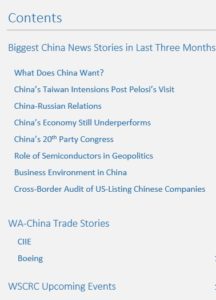
In the past quarter, the tensions between U.S. and China shows no sign of easing, especially after House Speaker Nancy Pelosi’s Taiwan visit. Despite the harsh environment, the Council—in cooperation with its educational arm, the Washington State China Relations Fund—continues to produce programs in an effort to present a more nuanced picture of the U.S.-China relationship. In this report, we analyzed some of the big news in the U.S.-China relationship since in the last three months. We also provided an update on the WA-China trade interactions, including the China International Import Expo and Boeing’s strategy with the Chinese market.
Read the full report here. 

Written by wscrc_admin · Categorized: Congressional Report, Headline News, Recent News, Washington-China Economic Relationship

Sep 29 2022

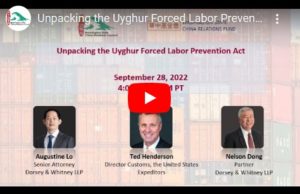
WSCRC Hosts a Timely Discussion on the Uyghur Forced Labor Prevention Act

On September 28, the WSCRC hosted a timely and important discussion to unpack the complexities of the Uyghur Forced Labor Prevention Act (UFLPA) with three experts in the subject matter. Our panelists included Augustine Lo, senior attorney at Dorsey and Whitney LLP, and Ted Henderson, Director Customs for the United States at Expeditors. The discusson was moderated by Nelson Dong, Partner at the Dorsey and Whitney.

The UFLPA was signed into Law by President Biden in December 2021 in response to allegations of the use of forced labor in China’s Xinjiang Uyghur Autonomous Region. A new guidance was issued by the U.S. Customs and Border Protection, CBP, in June. These changes are of critical importance for anyone who does business in China, handles trade, and/or has supply chains that include Chinese companies. Xinjiang is among the world’s major sources for cotton, polysilicon, and many other goods that are commonplace in the U.S. market. The new guidance introduces significant uncertainty and challenges to the trade community because of the unprecedented scope of the imports that may become targeted for the new enforcement measures.

Our speakers discussed the UFLPA’s requirements, CBP’s implementation and enforcement, best practices for business compliance, and the law’s implications for international trade and U.S.-China relations.

Click below to watch the discussion.

Written by wscrc_admin · Categorized: Headline News, Recent News

Sep 27 2022

Paul Triolo Talks about Semiconductors and its Important Role in U.S.-China Relations

On September 26, Paul Triolo, Senior Vice President for China and Technology Policy Lead at Albright Stonebridge Group discussed the contentious role that semiconductors play in the U.S.- China Relationship and global geopolitical landscape. A recognized expert in global technology, Paul provided a comprehensive and yet in-depth anyalsyis of the issue, inclulding the status and major players of the global semiconductor industry, the potential impacts of the recently passed CHIPS Act on U.S. semiconductor production and national security concerned related to China, and the outsized role that Taiwan plays in the global industry and the ramifications of any disruption of the Taiwanese semiconductor on global supply chains. Paul also examined the growth of the Chinese semiconductor industry and assess its role in the global landscape.

Click below to watch the webinar recording.

Written by wscrc_admin · Categorized: Headline News, Recent News

  • « Previous Page
  • 1
  • 2
  • 3
  • 4
  • 5
  • 6
  • …
  • 12
  • Next Page »

Search

Language Option

Social Media

Get In Touch

Contact Us

Address

Washington State China Relations Council

1301 5th Avenue, Suite 1500 Seattle, WA 98101-2611

Tel: (206) 441 - 4419

E-mail: info@wscrc.org

Copyright © 2026 Washington State China Relations Council. All rights reserved. · Privacy Policy